


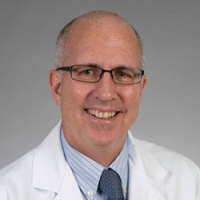
When I first conceived of MV Roots, featuring people born and bred in the Mohawk Valley doing great things away from home, Steve Rayhill came to mind. He is a superstar surgeon, specializing in liver, kidney, and pancreas transplantation.
Steve speaks fast. It’s hard to keep up, but you want to because he tells great stories. When I hear about his life—the adventures, challenges, successes, twists, and turns—the Odyssey comes to mind. Although Steve’s epic career warrants twelve thousand lines, MVL has room for highlights.
Book 1
Steve attended Middlebury College. He considered pre-med, but three C’s and a D his first semester derailed that plan. He liked physics—always had—so he decided he’d pursue that.
During his sophomore summer, his parents, seven siblings, grandfather, and their Lab were in their big green station wagon after a day at the beach. “There’s no room anywhere, but there are two young, super-fit hitchhikers on the side of the road, and my dad, being my dad, picks them up.” Listening from the backseat, Steve thought their lifeguarding tales sounded cool. He returned to Middlebury, took life-saving courses, and applied to every lifeguarding job on the Northeast National Seashore.
The following Memorial Day weekend, Steve headed to Nauset Beach, to try to pass their lifeguard test—a series of challenges that had him thinking he’d probably end up a busboy.
“I was pretty sure my lungs collapsed after my first swim.” But he survived the initial 48-degree surf and six-foot waves and sailed through first aid and the interview, advancing to navigating shorebreaks. With no prior surfboard experience, Steve ran out with a 12-foot rescue board just as a peak set of waves was coming in. “The first wave picked me up and threw me twelve feet onto the beach, and then I got sucked back down.” He made several attempts but was ultimately rescued by lifeguards. His face and foot both bleeding, mortified by his defeat, the head guard came over and said,”You want to try again?” He did and ended up with twenty saves and twenty assists a summer—Steve loved saving lives.
Book 2
Steve graduated from Middlebury, a physics major, with a C+ average or thereabouts. At the time, his ambition was more lifeguarding, ski-bumming, and traveling around Europe. He had money saved, and he just needed a self-sustaining wage. He lifeguarded more, wrote computer programs, and at one point joined his brother Rich in Alaska to work on a fishing boat, where to this day he’s astonished he didn’t die.
Money in hand, Steve was headed west to ski when his 48-year old mom got really sick. He recounts a medical-textbook-level description of his mom’s heart problems, still seemingly frustrated by his inability to fix what he could easily fix today. After three operations and a “Say goodbye to your mom. I don’t think I can save her,” their mother lived miraculously for another decade— an experience that has stayed with him throughout his career. “Dr. Fitz Parker changed the Rayhill family. He kept my mom alive for ten more years. That was a tough situation, and it made me work harder. I was more intense. I spent more time in the hospital because of that.”
Book 3
At this point, Steve tackles, “What am I going to do with my life?” His plan: “I’ll do pre-med; if I like it I’ll consider medicine. Or I’ll do film school, and if I like that, I’ll make movies.”
He first visited Cornell because he was born when his dad was at Cornell. They tell him: “You don’t have all the courses; you can’t even apply. Why don’t you go to Columbia? They have a pre-med program.”
Steve’s path zigzagged—he returned to the Cape for another tour of lifeguarding, which nudged him toward pre‑med.
Eventually he applied to Columbia, started his pre-med courses and worked like a maniac to compensate for his undergraduate C’s. He found the courses really interesting, earned “ridiculous” grades, and ended up getting into Columbia.

Book 4
Columbia was heavy-duty studying, but he loved med school and he loved Columbia’s ethic: “We’re the best in the world”—and their standards always stayed with him.
He earned Alpha Omega Alpha (AOA) at Columbia, the prestigious Pharmacology Award, and earned the American College of Cardiology research grant for two years—a big deal. He did research for the world’s expert in electrophysiology and ventricular arrhythmias. His mom was there for all of that. His plan was to be a heart surgeon —the heart has a lot of physics, electronics, and pumping which was cool to him, and of course, his mom’s sickness influenced him.
Steve was asked to stay for his residency by the head cardiac surgeon at Columbia. But, he was sick of Washington Heights — it had the highest murder rate in the city. Columbia was excellent for hearts, but Stanford was too, and he had two siblings out there.
Book 5
Steve headed cross-country in his grandfather’s old rusted-out Buick, fondly referred to as the “green machine.” By the time he hit Palo Alto, the odometer had broken, he had a metal plate covering a hole underneath his feet, and the local cops were following him. He drove it until twenty-foot flames were coming out of the front somewhere on Route 101— “I didn’t want to stop driving it because it was a family car.”
He spent five years of residency at Stanford, with two years in their research lab—ten years later, they were still talking about what he did in the lab. He was the only resident ever to win the Chief Resident of the Year award. “I worked really hard to try to be as good a surgeon as I could because I knew what it was like to have somebody save your mom’s life.” Steve’s standards for himself were to take on more than double the number of cases that all his Stanford colleagues did: the average was 500 cases, a few handled 800, and Steve was responsible for 1,700 cases.
Donald Dafoe, brother of movie star Willem Dafoe, came to Stanford to start an abdominal transplantation program, and everybody loved him, including Steve. A few different people told Steve he should think about transplant—“It’s your destiny,” one Star Wars reference he remembered, and another: “It’s the future.” Dafoe called Wisconsin to recommend Steve and Wisconsin called him and asked him to come out and do their fellowship. He didn’t want to move to Madison, Wisconsin and thought he might be ruining his life, but it was the best place for transplant training and there was no way he could turn it down.
Book 6
He went to Wisconsin, and he loved it. “I felt like I played for the Yankees when I was there. One day I went to work, making the sign of the cross on myself, thinking, ‘I’m the luckiest guy on earth. I get to come and work with these people—from the orderlies sweeping the floors to the world-famous attendings.’”
As much as he never wanted to leave Wisconsin, transplant is super-technical surgery and he knew he had to operate, especially right out of training. To stay in Madison meant spending half the year in a lab doing non-operative work. But 170 miles from Madison is a surgical genius interested in liver transplants: Dr. Wu.
Book 7
“I would do every case with Wu. I did all my own liver transplants, and then I would do Wu’s liver transplants as his assistant.”
They had the best results in the history of liver transplant. The pair also hold the world record for the youngest recipient: a 5-lb, 18-day-old baby who they operated on in December 2000—the kid is now 26. The duo had a busy transplant program—they were on call for a year and a half straight. “I learned a lot from Wu. He enhanced my abilities in liver, and I enhanced his in other things—I spend a lot of time talking to my patients, and sometimes I get in trouble for it, but I try to relieve them.”
Book 8
There is a theme when listening to Steve’s achievements and the words that come to mind are “best in class.” His CV (medical résumé) is sixty-two pages long. Top programs recruited him, premier publications published his work, and his titles often included head, leader, or chief. Steve’s a world-renowned surgeon, and a gifted one. Throughout his career, donors are sacred, and the patients are his priority. “Having lived through those weeks when my mom was dying—hanging on every word of the surgeon and living for every update— I knew what it was like to have a team of doctors save your mother’s life. It made me feel an intense amount of responsibility to my patients.”
Book 9
Whether or not Odysseus is a hero has been debated for centuries—but there is no debating whether or not Steve Rayhill is a hero—his reputation is built on real-life feats, not mythical ones. He has saved innumerable lives, and has the bedside manner that prompted a former patient to drive 2,000 miles to see him. Steve personifies integrity and comes from a long line of it; “Every time I left the house, my Dad would say, ‘Do the right thing’—so that’s the way I live my life—that’s my motto. And I do that in medicine to a T.”
Like Odysseus, Steve’s journey has taken him far from home—but a move back to the Mohawk Valley has always been a consideration. When Steve retires the surgical knife, we may see him come back. That part of his odyssey is to be continued.
